


The equipment that worked for your operation five years ago may not be the equipment you need today.
Business requirements change. New contracts, different products, higher volumes, changes to your sites and operating environment, and new processes can all place different demands on materials handling equipment.
At SHS, we believe the right equipment decision starts with understanding the operation, not choosing a product.
We spoke to Harry Johnston, Business Development Manager – North & Ireland at SHS, about the signs that an operation may have outgrown its current equipment, what businesses often overlook, and why the right solution starts with understanding the application.
HAS THE APPLICATION CHANGED?
A new contract can fundamentally change what a business needs its equipment to do.
One recent SHS customer had traditionally focused on pallet movement, where a standard electric pallet truck was suitable. A new white goods contract changed that. Drivers now needed to move products weighing more than 200kg up stairs.
A standard off-the-shelf solution wasn't suitable, so SHS worked with the customer to develop modifications that provided a safer and more practical solution.
The equipment hadn't necessarily failed. The application had changed.
Whenever your products, loads, volumes or processes change, it's worth asking:
Is our current equipment still right for what we're asking it to do?
WHAT ARE YOUR OPERATORS TELLING YOU?
Equipment problems don't always appear as breakdowns.
Are operators consistently choosing one truck over another, or swapping equipment between drivers? This can indicate that some equipment is easier, more comfortable or more reliable to use, or that another asset is creating problems.
Operators can also be blamed for poor handling or misuse when the equipment itself may not be suitable for the application.
WHAT IS THE EQUIPMENT REALLY COSTING YOU?
Purchase price is only one part of the cost of owning materials handling equipment.
Repeated repairs, breakdowns and downtime can quickly increase the cost of an asset.
Rather than comparing the cost of the next repair with the price of a replacement, look at the repair history and cumulative maintenance cost of each asset.
That's why it's important to look at:
- Repair and maintenance costs
- Breakdown frequency and downtime
- Asset age
- Recurring faults
- Reliability
- Suitability for the current application
A four- or five-year-old truck that remains reliable may continue to be a good asset. But if an asset is becoming increasingly expensive to maintain, unreliable in operation, or experiencing recurring component failures, it may be time to consider whether continued repairs are still the right approach.
The same applies to equipment bought on price alone. A low-cost truck may look attractive initially, but repeated breakdowns, limited support and a shorter working life can make it the more expensive option over time.
"The cheapest truck to buy isn't necessarily the cheapest truck to own."
ARE YOU BUYING THE RIGHT EQUIPMENT FOR THE OPERATION?
The right equipment decision starts with understanding the environment in which it will operate.
A business may approach SHS looking for a particular pedestrian or counterbalance stacker. Once the operation is understood and a site survey is completed, however, a different solution may prove more appropriate.
For example, a straddle stacker may be more suitable where space is limited. Understanding the pallet type, doorway height and required lift height can also help identify potential issues before equipment is purchased.
A site survey helps match equipment to the operation, rather than simply the specification requested.
HOW WELL IS YOUR EQUIPMENT SUPPORTING YOUR OPERATION?
Take 60 seconds to check.
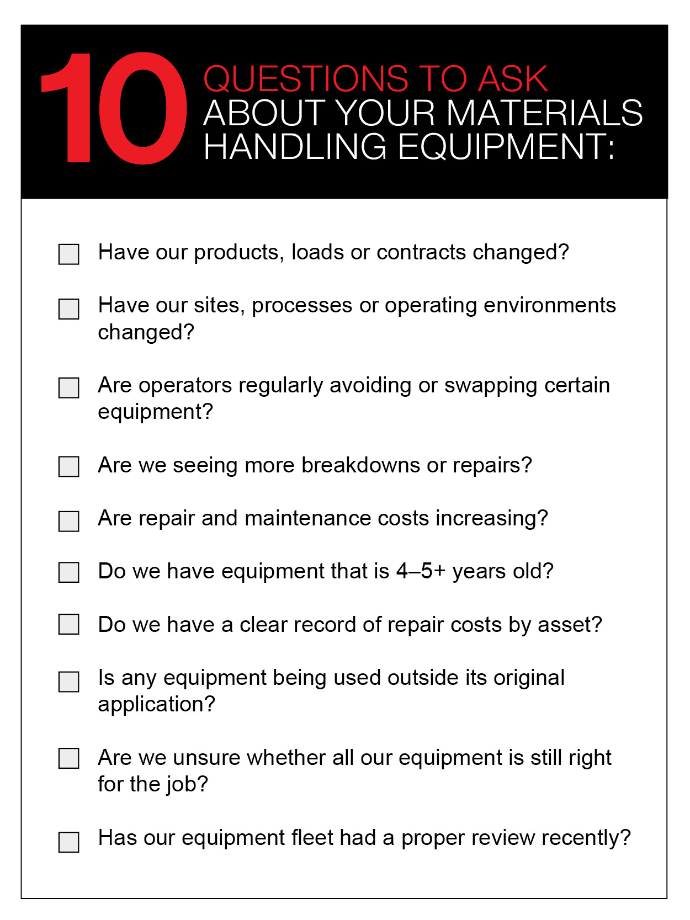
What are the answers telling you?
0-2 checked
Your equipment may be performing well, but regular reviews can help identify opportunities before issues become costly.
3-5 checked
There may be opportunities to improve reliability, suitability or operating costs.
6+ checked
A more detailed review of your equipment, applications and maintenance history could provide valuable insight.
DON'T WAIT FOR THE NEXT BREAKDOWN
A review doesn't automatically mean replacing equipment. It means understanding what you have, how it's performing, what it is costing to maintain and whether it is still aligned with the operation.
At SHS, we can help businesses identify opportunities to improve safety, reliability, efficiency and operational continuity — from equipment selection and supply through to maintenance and ongoing engineering support.
If your operation has changed, your equipment strategy may need to change with it.
TALK TO SHS ABOUT AN EQUIPMENT REVIEW OR SITE SURVEY.
Design. Supply. Maintain.